
Speak to our public sector team
Tell us about your department, sector or programme and we'll get back to you about a briefing and how to buy.
- A straightforward reply
- Guidance shaped around your programme
- No obligation
GemForge Labs for Government & National Resilience
Hands-on training for the teams who defend critical national infrastructure, and the evidence to show they are ready.
National resilience
Essential services depend on one another, so a failure in one can spread to the next. The people defending them should already have rehearsed that.
Energy
Water
Transport
Telecoms
Health
Finance
Government
Emergency services
Essential services rarely get a second chance. Teams work through realistic compromises, from first alert to recovery, so the decisions are already familiar when they matter.
Follow an intrusion from the first indicator to the final report, preserving evidence and building the timeline as you go.
Multi-host enterprise environments for red team and incident response work, built for enterprise and government teams.
Deal with an attack that is already taking systems offline. Decide what to isolate, what to keep running and how to recover.
Regain control of the cloud platforms and identity systems that modern services depend on.
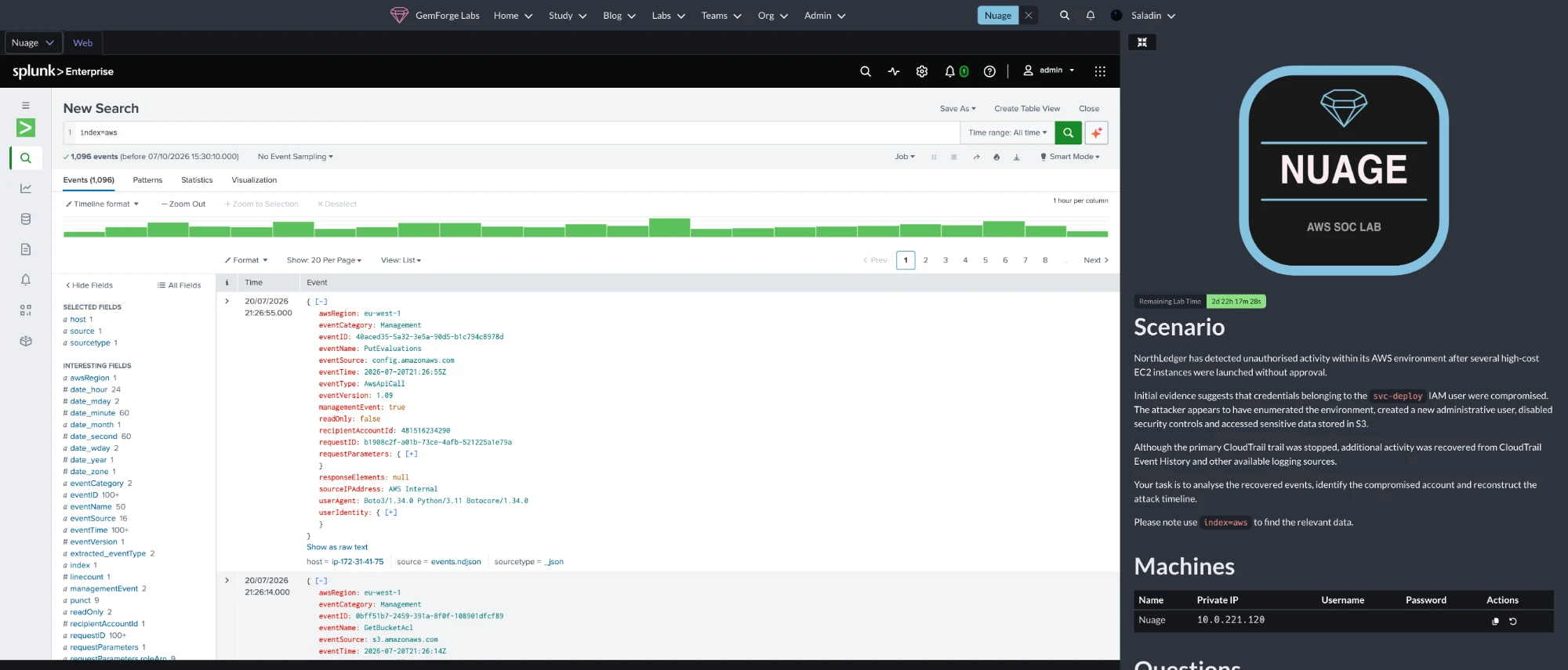
Defence improves when people have walked the attack path. Each learner works in a private, disposable environment, entirely separate from your operational networks.
From reconnaissance through to post-exploitation, against targets built for the purpose.
Every environment is isolated and destroyed afterwards, so practice never puts a real service at risk.
As AI is adopted into public services, a new class of failure arrives with it. Staff learn how LLM applications are manipulated and how to harden them before they are deployed.
Practise manipulating and then securing AI-powered applications in a safe environment.
Labs that need a model use GFL AI, which is included in the plan.
No API keys, accounts or infrastructure for your team to arrange.
Give ministers, regulators and boards a clear view of capability across teams and organisations, based on what people have demonstrated rather than what they have attended.
See progress for every team in one place, and assign labs, modules and pathways from the same view.
Set the route for each function, so an analyst, an engineer and an incident lead each train on what their job demands.
Run a dated exercise for a single organisation, with its own roles and participants and content released on schedule.
Labs and modules are mapped to the DoD Cyber Workforce Framework.
Exercises
Resilience depends on leaders, responders and technology working together. Exercises put all three under realistic pressure, then report on how it went.
Like rehearsing a mission, an exercise puts leaders, responders and technology through the same unfolding scenario. What goes well, and what does not, becomes the plan for the next rehearsal.
Walk senior decision-makers through a realistic incident, with new information released as the scenario unfolds.
Pair the discussion in the room with practical work, so decisions are tested against real evidence.
A ready-made scenario your team launches on the platform, on your schedule, using your lab hours.
A red and blue team exercise designed and run with our consultants, ending in a detailed report.
Agree the scenario
We settle the scenario, the roles and the dates with you.
Brief participants
Each participant receives their connection details and role briefing on the platform ahead of the start.
Run the exercise
Everyone sees what their role would see, with information released to the whole group, a role or one person on the dates you set.
Report
Leadership is notified as soon as the exercise report is released.
DCWF
The DoD Cyber Workforce Framework (DCWF) defines the work roles of the cyber workforce. Our content is mapped to it, helping you see which roles your training supports.
Hands-on labs where people practise the work, mapped to DCWF work roles.
Structured modules that build the knowledge behind the work, mapped to DCWF work roles.
We track continuing professional education (CPE) credits for completed labs and modules.
Outcomes
A single subscription gives each team the full labs library, training modules and a monthly GFL AI allowance, whether you run one department or a whole sector.
We provide the environments. You direct the programme.
How to buy
We work with your procurement and security teams from the first conversation, so buying is as straightforward as the training.
Tell us how your organisation prefers to buy and we will help you find the right route.
Share what your assurance process needs and we will help you answer it.
We help you set up accounts, teams and pathways so your people can begin quickly.
Tell us about your department, sector or programme and we'll get back to you about a briefing and how to buy.
Answers for departments, agencies and infrastructure operators
Cookie Preferences
We respect your right to privacy. You can choose not to allow some types of cookies. Your cookie preferences will apply across our website.
These are required cookies for the site to function.
These cookies help us improve the site by tracking which pages are most popular and how visitors move around the site.
These cookies are used to improve your advertisement experience across our website, we have disabled these by default